


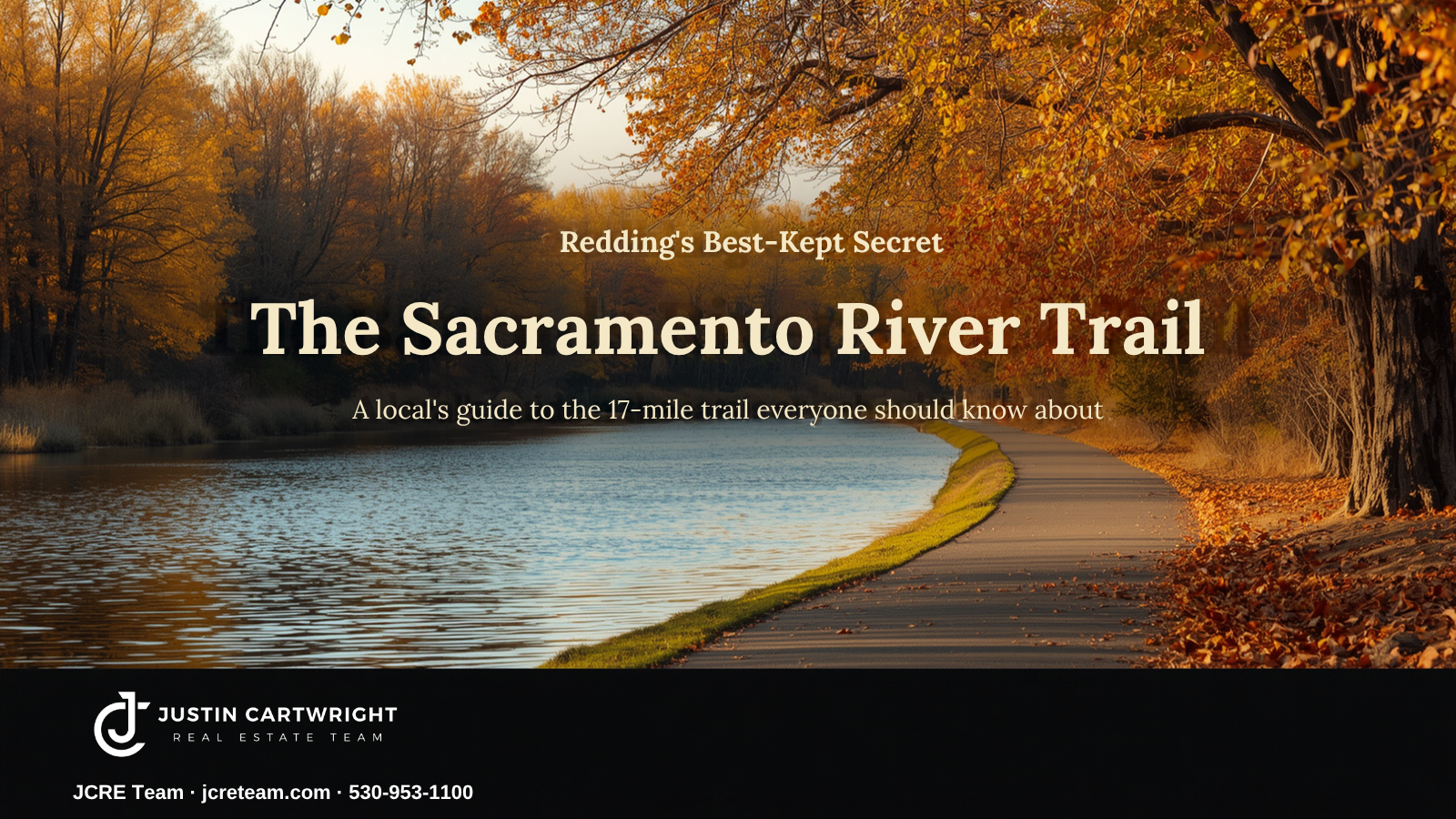
I get asked some version of this question almost every week from people looking to relocate to Redding: “What is there actually to do here?” My answer almost always starts in the same place — grab your walking shoes and go stand on the Sundial Bridge at sunset.
The Sacramento River Trail is one of those things that’s easy to take for granted if you grew up here, the way I did. But when I’m working with a family moving up from the Bay Area or Sacramento, showing them the trail is usually the moment the move starts to feel real to them. It’s free, it’s beautiful, and it runs right through the middle of town.
With the weather finally cooling off and fall settling in, this is the best stretch of the year to actually use it. So here’s an honest, practical guide to the trail — what it is, what it costs, and why it’s worth factoring into where you decide to live.
What the Sacramento River Trail Actually Is
The Sacramento River Trail is a paved, 17.4-mile path that loops along both sides of the river through the heart of Redding. It’s flat enough for a stroller and interesting enough that longtime locals still find new stretches of it. The Rails-to-Trails Conservancy has recognized it as one of its Hall of Fame trails nationally, which tells you it’s not just a nice local perk — it’s genuinely one of the better urban trail systems in the country.
Most people start at the Sundial Bridge, the glass-decked pedestrian bridge designed by Santiago Calatrava that’s become Redding’s unofficial postcard image. From there the trail winds past Turtle Bay, over the century-old Diestelhorst Bridge, across the Ribbon Bridge, and eventually connects to the Sacramento River Rail Trail, which continues out toward Keswick Dam through an old train tunnel. You can do a short 20-minute loop around the bridge with a toddler, or turn it into a serious half-day ride on a road bike. Both are common.
Fall Is the Best Time to Walk It
Redding summers are hot — anyone who’s lived here through July and August knows it — so fall is when the trail really comes alive again. Mornings are crisp, the crowds thin out compared to summer weekends, and the cottonwoods and oaks along the river start turning color, especially in the stretches near Caldwell Park and along the rail trail extension. It’s also prime time for wildlife watching along the water — deer, river otters, and the occasional bald eagle show up regularly for people paying attention.
If you’re weighing a move to Redding and you’re visiting to house-hunt this fall, block out an hour to walk part of the trail. It tells you more about daily life here than almost any other single stop on a relocation tour.
Sundial Bridge and Turtle Bay: What’s Free and What Isn’t
This trips people up, so it’s worth spelling out clearly. The Sundial Bridge itself is completely free and open every day — you can walk or bike across it any time, no ticket required. It’s also one of the main access points to the trail itself.
Turtle Bay Exploration Park, the museum and gardens next to the bridge, is a separate, paid attraction. As of this year, general admission runs $22 for adults (16–64), $18 for seniors (65+), $18 for kids (3–15), and it’s free for children under 3. That admission covers the museum, indoor and outdoor animal exhibits, the arboretum and gardens, and play areas across the park’s 300 acres. If you’re bringing family through to see the area, it’s a worthwhile add-on to a trail walk, but you don’t need a ticket to enjoy the bridge or the trail itself.
Neighborhoods Where the Trail Is Part of Daily Life
I show a lot of buyers around Redding, and one thing I’ve noticed: the closer a home sits to the trail — downtown and the riverfront area, the neighborhoods around Caldwell Park, and the pockets up toward Keswick near the rail trail extension — the more often people mention it, unprompted, as a reason they love where they live. It’s not a formal amenity that shows up as a line item on a listing, but it’s the kind of thing that quietly shapes quality of life here. If daily access to walking or biking trails matters to you, it’s worth asking about proximity to the trail system specifically when you’re touring homes, not just proximity to “downtown” in general.
Why This Matters If You’re Relocating Here
A lot of what I do for people moving to Redding isn’t really about square footage or school ratings — it’s helping them understand what everyday life actually looks like here. The trail is a good example. It’s free, it’s low-key, and it’s used by regular people on a Tuesday morning, not just tourists. For buyers coming from places where a comparable trail system would mean a membership fee, a drive, or both, that’s a real quality-of-life difference worth weighing alongside price per square foot.
If you’re upsizing into a place with more room to actually use a trail like this, or downsizing and want to trade yard maintenance for easy walkable access to something like it, it’s worth telling your agent that up front. It changes which neighborhoods make sense to focus on.
A Few Practical Notes
Parking is easiest at the Sundial Bridge/Turtle Bay lot off Sundial Bridge Drive, or at Caldwell Park, which also has restrooms and picnic areas. The trail surface is paved and well maintained the entire way, but a few stretches near the rail trail extension get shaded and can stay a little damp after rain once the wet season starts, so good shoes help. Cell service is generally solid along most of the route if you’re walking alone, and the trail sees enough regular foot and bike traffic that it feels comfortable at most hours during the day.
Thinking About a Move to Redding?
If you’re relocating to Shasta County, buying your first home here, or looking to upsize or downsize into a neighborhood where you can actually use something like the river trail day to day, I’d genuinely enjoy showing you around — the trail included. That’s a big part of what makes this job good.
530-953-1100 · jcreteam.com/contact · [email protected]
Sources: trail mileage and route details from Visit Redding and the American Trails organization; Turtle Bay Exploration Park admission pricing from Turtle Bay’s official ticketing portal, current as of September 2026.
About Justin Cartwright — Justin Cartwright is a third-generation Shasta County resident and licensed REALTOR® with Waterman Real Estate in Redding, CA. He and the JCRE Team specialize in helping buyers and sellers navigate the Redding and greater Shasta County market with honest guidance and genuine care. DRE License #02093872 · Waterman Real Estate, 1760 Churn Creek Rd, Redding, CA 96002 · 530-953-1100.