


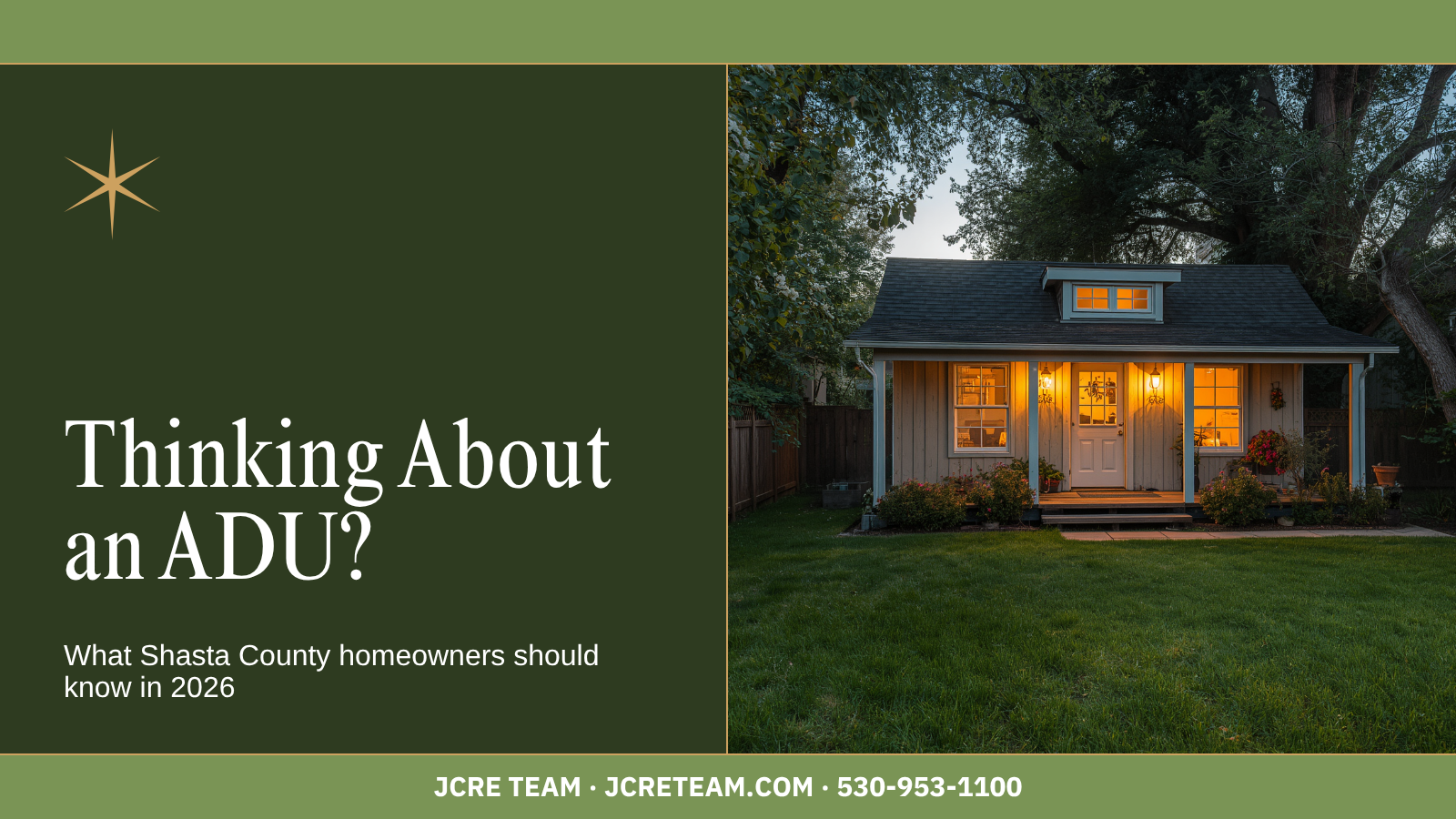
If you’ve driven around Redding lately, you’ve probably noticed more backyards getting a second, smaller home tucked into them. A little cottage behind the main house. A converted garage with its own front door. Grandma’s place out back.
Those are ADUs — accessory dwelling units — and they’ve quietly become one of the most talked-about topics I get asked about at the kitchen table. Sometimes it’s a homeowner who wants to bring an aging parent closer without everyone living on top of each other. Sometimes it’s someone eyeing a little extra rental income. And sometimes it’s just a family that needs more room and would rather build than move.
California changed several of its ADU rules on January 1, 2026, and most of the changes make these projects easier and faster than they used to be. So I wanted to walk through what an ADU actually is, what’s new this year, and the honest questions worth asking before you break ground here in Shasta County.
What an ADU actually is
An ADU is a second, self-contained living space on a property that already has (or will have) a main home. It has its own kitchen, bathroom, and entrance. It can be detached — a standalone cottage in the backyard — attached to the main house, or carved out of existing space like a garage or basement.
There’s also a smaller cousin called a JADU, or junior ADU. That’s a unit of up to 500 square feet created within the walls of the existing home, usually with its own entrance and a small kitchen, sometimes sharing a bathroom with the main house.
The reason the state keeps loosening the rules is simple: California is short on housing, and ADUs add homes without changing the character of a neighborhood or requiring new roads and infrastructure. For a homeowner, that policy goal turns into real flexibility on your own lot.
What California’s 2026 rules changed
A handful of new laws took effect this year, and a few are worth knowing about:
Faster permit reviews. Under SB 543, your local agency now has to tell you within 15 days whether your ADU application is complete. If they miss that window, the application is automatically deemed complete. They also can’t keep moving the goalposts — resubmittals only get reviewed for the items they already flagged.
Fewer owner-occupancy strings on JADUs. Historically, if you built a junior ADU, you generally had to live on the property. Under AB 1154, a city or county can only require owner-occupancy for a JADU that shares a bathroom with the main house. Give the JADU its own bathroom, and that requirement goes away.
Big breaks on impact fees. This is the one that surprises people. ADUs of 750 square feet or smaller are exempt from all impact fees, and units under 500 square feet are exempt from school impact fees. For anything larger, the fees have to be proportional to the ADU’s size relative to your main home — not a flat charge that treats a backyard cottage like a brand-new subdivision house.
None of this means the process is a rubber stamp. But the trend is clearly toward fewer hurdles, and that matters when you’re budgeting time and money.
What it costs — and a Shasta County shortcut
I’ll be straight with you: an ADU is not a cheap project, and anyone who tells you otherwise is selling something. Statewide, the soft costs alone — permits, design, engineering, and utility hookups — can run anywhere from $12,000 to $77,000 before construction even starts, depending on your lot, your utilities, and the size of the build. Construction is on top of that.
Two things work in your favor locally. First, Shasta County offers pre-approved ADU plans free of charge to property owners and contractors building in the unincorporated areas of the county. Starting from a pre-approved design can shave real money and weeks off the front end, because a chunk of the review is already done. The City of Redding also has its own building resources and permit center if your property is inside city limits.
Second, our construction and land costs up here are still gentler than what you’d face in the Bay Area or Sacramento. That doesn’t make an ADU free — but it does mean the math pencils out more often than it does down south.
My honest advice: get a real bid before you fall in love with the idea. A short conversation with a local contractor and the county or city permit center will tell you more about your specific lot than any online estimate ever will.
The rental income question
For a lot of homeowners, the appeal is the monthly check. So here’s the local reality: as of 2026, a one-bedroom in Redding rents for roughly $1,030 to $1,085 a month, and rents have been fairly flat over the past year. A well-built ADU in a good part of town can command that or a little more.
Run your own numbers before you count on it. Take the realistic monthly rent, subtract for vacancy, maintenance, insurance, and any financing, and see what’s actually left. For some families the rent covers a big piece of the construction loan over time. For others, the bigger win is having a place for a college kid, a returning parent, or a home office that isn’t the corner of a bedroom. Both are valid reasons — just be clear with yourself about which one is driving the decision.
How an ADU affects your value and your taxes
An ADU generally adds value to your property, because you’re adding livable square footage and, often, an income stream. When it comes time to sell, that flexibility appeals to a wide range of buyers — multigenerational families, investors, and folks who want a mortgage helper.
On taxes, here’s the part people forget: building an ADU is new construction, so the county assessor will add the value of the ADU to your assessment. The good news under California’s Prop 13 rules is that they don’t reassess your entire property — your existing home keeps its original base-year value, and only the new unit gets added on. So you’ll see a supplemental increase tied to the ADU, not a reset of your whole tax bill. It’s worth factoring that ongoing cost into your plan.
A few honest questions before you build
Before you commit, I’d sit down and ask yourself a few things: Do I actually have the yard, setbacks, and utility access to make this work? Am I building for family, for income, or for resale value — and does the budget match that goal? Have I gotten a real bid, not a ballpark? And am I planning to be in this home long enough for the investment to make sense?
If the answers line up, an ADU can be one of the smarter things you do with your property. If they don’t, it’s better to find that out on paper than halfway through a build.
I’ve helped a lot of Shasta County families think through whether adding a unit — or buying a home that already has one — is the right move. If you’re weighing it and want a straight opinion, I’m always glad to talk it through.
Reach out anytime: 530-953-1100 · jcreteam.com/contact · [email protected]
Sources: California Department of Housing & Community Development and 2026 legislative summaries (SB 543, AB 1154, AB 462); Shasta County Department of Resource Management (pre-approved ADU plans); statewide ADU permit cost estimates; Redding rental data from Rent.com, Zumper, and RentCafe (2026). Figures are estimates and change over time — confirm current permit fees and rules with the City of Redding or Shasta County before you build.
About Justin Cartwright — Justin Cartwright is a third-generation Shasta County resident and licensed REALTOR® with Waterman Real Estate in Redding, CA. He and the JCRE Team specialize in helping buyers and sellers navigate the Redding and greater Shasta County market with honest guidance and genuine care. DRE License #02093872 · Waterman Real Estate, 1760 Churn Creek Rd, Redding, CA 96002 · 530-953-1100.