


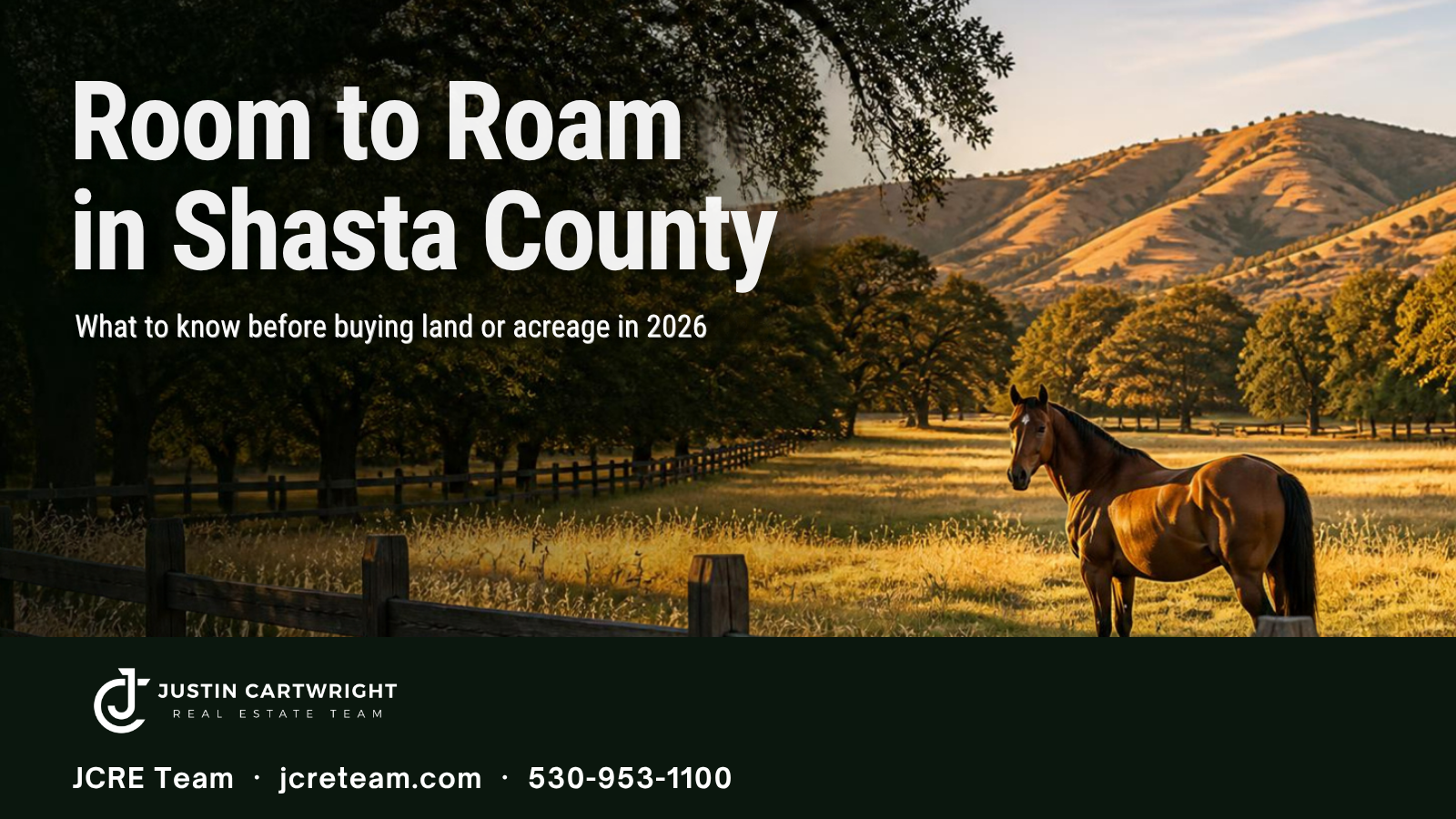
Some of the best conversations I have with buyers start with a sentence like, “We just want some room.” Maybe it’s a family outgrowing a subdivision lot in Redding. Maybe it’s someone relocating from the Bay Area or Southern California who has dreamed for years of a place with a barn, a garden, and no neighbor’s window ten feet away.
I get it. I grew up here, and the open space around Redding is a big part of why so many of us stay. But buying acreage is a different animal than buying a house in town. The land itself carries questions that a standard home purchase never asks: who maintains the road, what the zoning allows, how the lender views the property, and what the fire map says.
Here’s how I walk my own clients through it in 2026.
Where Acreage Tends to Be Around Redding
Most acreage in Shasta County sits outside city limits, in unincorporated areas governed by the county rather than a city. A few areas buyers commonly look at:
- Palo Cedro and Millville to the east, with rolling oak land, pasture, and a lot of horse properties.
- Bella Vista, northeast of Redding, with a mix of small ranchettes and larger parcels.
- Happy Valley, south and west of Anderson, with flatter ground and a long agricultural history.
- Igo and Ono, out west in the foothills, where parcels are often larger and more remote.
- Shingletown, up the Highway 44 corridor, where you trade valley heat for pines and higher elevation.
Each one feels different. Commute time, elevation, winter weather, and how far you are from a grocery store all change quickly once you leave town. Drive the area at the times you’d actually be commuting before you commit.
Zoning: What You Can Build and Keep in Shasta County
Zoning decides what you can actually do with the land, and it’s the first thing I check. Shasta County uses zone districts such as Rural Residential (R-R), Limited Agriculture (A-1), and Exclusive Agriculture (E-A), and each one comes with its own minimum parcel sizes and allowed uses.
That matters if you’re planning to:
- Keep horses, cattle, goats, or poultry
- Build a shop, barn, or second home
- Add an accessory dwelling unit (ADU) for a parent or adult child
- Split the parcel down the road
The county has updated its ADU rules to line up with state law and even offers pre-approved ADU plans for unincorporated areas. Still, animal limits, setbacks, and building rules depend on the specific zone and parcel, so I always send buyers to the source: the Shasta County Department of Resource Management, Planning Division. A quick call with the parcel number in hand can save a lot of heartache. Also ask whether existing barns, shops, or living spaces were permitted. Unpermitted structures can affect insurance, financing, and resale.
Financing Acreage Is Different Than Financing a House
This is where I see the most surprises, so it’s worth slowing down.
Home on acreage vs. raw land. A house with a few acres can often be financed with a regular conventional, FHA, VA, or USDA loan. Raw land with no home is another story. Land loans usually require a larger down payment, shorter terms, and higher rates, and many local buyers end up working with a credit union or portfolio lender for those.
Acreage and appraisals. Fannie Mae doesn’t set a hard maximum on acreage, but the property needs to be primarily residential and typical for the area. The tricky part is comparable sales. Rural appraisals can be harder when there aren’t many similar recent sales nearby, and lenders may balk if the property looks more like a working farm than a home.
USDA loans. A lot of buyers don’t realize that most of Shasta County outside the Redding urbanized area is USDA-eligible, including places like Palo Cedro and Cottonwood. USDA has income limits and the home must be your primary residence, so check both the address and your household income on the USDA eligibility site.
My honest advice: talk to a local lender before you start touring rural property, not after you’ve found the one.
Access, Roads, and Easements
In town, the city fixes the potholes. Out in the county, plenty of homes sit on private roads, and that brings real questions.
- Is there legal, recorded access? Driving in on a road isn’t the same as having a recorded easement to use it.
- Is there a road maintenance agreement? Under California Civil Code Section 845, people who share a private road share the cost of keeping it in repair. A written agreement spells out who pays what. Without one, costs are shared based on use, which can get messy between neighbors.
- What other easements cross the land? Utility lines, ditch access, or a neighbor’s right to cross can all limit where you build or fence.
Read the preliminary title report carefully, and don’t hesitate to ask a title officer or attorney to explain anything unclear.
Fire Hazard Zones and Insurance
You can’t talk about rural Shasta County without talking about fire. CAL FIRE updated its Fire Hazard Severity Zone maps for State Responsibility Areas effective April 2024, and maps for Local Responsibility Areas in Northern California were released in early 2025. You can look up any parcel on the state’s online viewer or through Shasta County’s GIS.
Your zone affects building standards and, increasingly, insurance. Get an insurance quote early in escrow, ideally before your contingencies are removed. Some buyers end up pairing the California FAIR Plan with a separate policy for everything else, and that changes the monthly budget. I’d much rather you know that on day three than day twenty-eight.
Water, Power, and Internet
Water is the big one. Most acreage relies on a private well, and some parcels have ditch or irrigation district rights. Ask what water rights, if any, transfer with the property, and get the well tested for flow and quality. I’ve covered wells and septic in detail in a separate post, so I’ll keep it short here: don’t skip the inspections.
Power is usually PG&E. If a parcel isn’t already served, get an estimate for extending service before you buy. Bringing power a long distance can be expensive. Some owners add solar or a generator for outages.
Internet varies a lot from road to road. Some areas have cable or fiber nearby, while others rely on fixed wireless or satellite. If you work from home, verify actual service at the specific address, not just the general area.
Your Shasta County Acreage Due-Diligence Checklist
Before you remove contingencies, make sure you’ve checked:
- Zoning and allowed uses with Shasta County Planning
- Permit history for the home, barns, shops, and any ADU
- Recorded legal access and any road maintenance agreement
- Easements on the preliminary title report
- Fire Hazard Severity Zone and an actual insurance quote
- Well flow and water quality tests, plus septic inspection
- Water rights or irrigation district service, if any
- Power, internet, and cell coverage at the property
- Boundary lines and fencing (consider a survey on larger parcels)
- Lender and appraisal fit for the property type
Ready to Find Your Piece of Shasta County?
Buying land should feel exciting, not overwhelming. My job is to help you ask the right questions early, so the property you fall for is one you can actually finance, insure, and enjoy for years.
If you’re thinking about acreage, a horse property, or a few quiet acres outside Redding in 2026, I’d love to help you sort through the options. No pressure, just honest local guidance.
Call or text: 530-953-1100 · jcreteam.com/contact · [email protected]
Sources: Shasta County Housing Element and Zoning Code (Title 17); Shasta County Fire Hazard Severity Zones page; CAL FIRE/Office of the State Fire Marshal FHSZ maps; USDA Rural Development eligibility; Fannie Mae appraisal FAQs; California Civil Code Section 845.
About Justin Cartwright — Justin Cartwright is a third-generation Shasta County resident and licensed REALTOR® with Waterman Real Estate in Redding, CA. He and the JCRE Team specialize in helping buyers and sellers navigate the Redding and greater Shasta County market with honest guidance and genuine care. DRE License #02093872 · Waterman Real Estate, 1760 Churn Creek Rd, Redding, CA 96002 · 530-953-1100.