


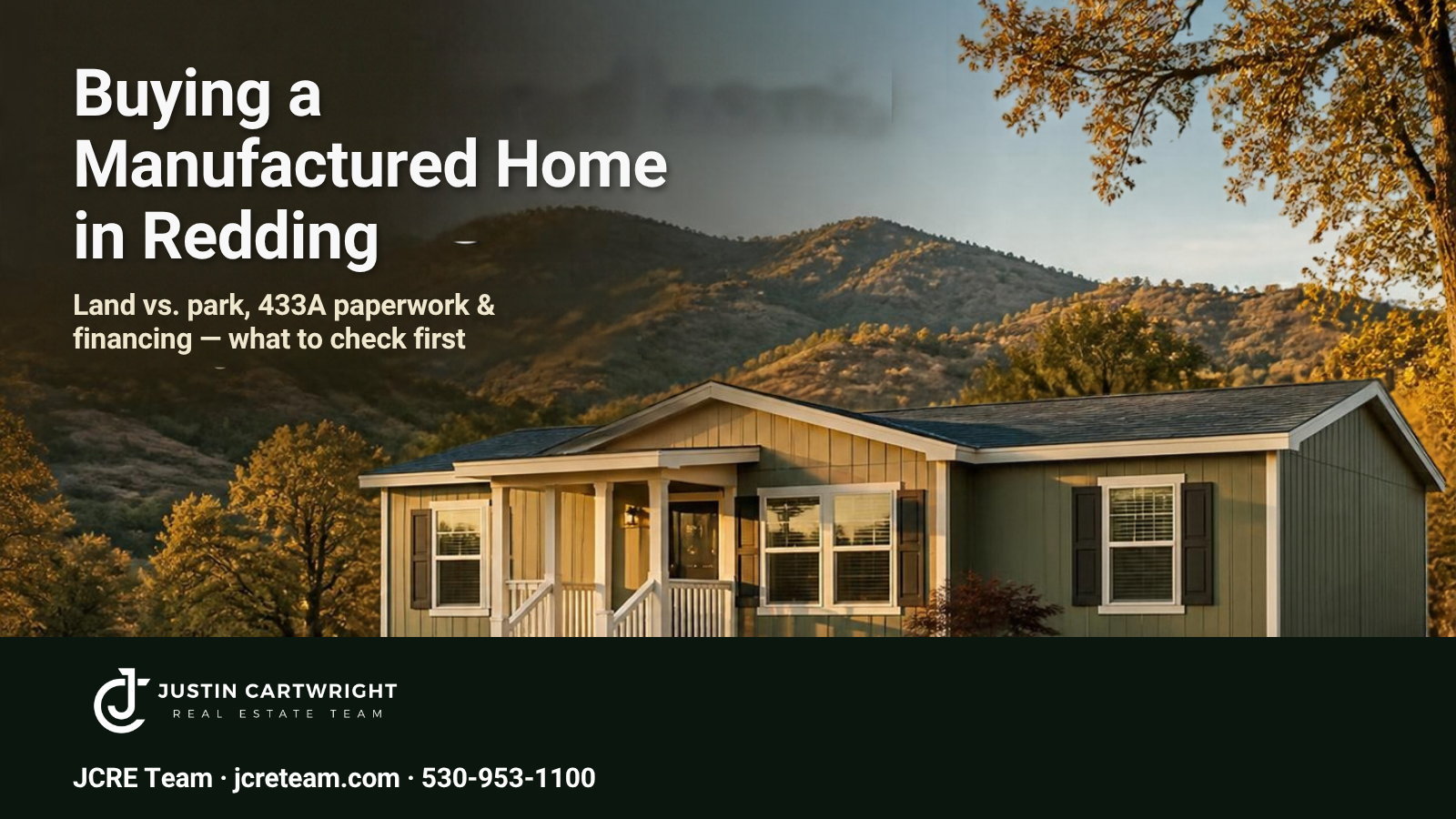
Drive almost any back road in Shasta County — out toward Palo Cedro, Millville, Cottonwood, Shingletown, or up Highway 299 — and you’ll see manufactured homes sitting on an acre or two with a shop, a garden, and a view. Inside Redding, you’ll find well-kept parks full of folks who wanted one-level living without a big mortgage.
With 30-year mortgage rates above 7% this fall, I’m getting more questions about manufactured homes than I have in years. It makes sense. For first-time buyers, downsizers, and anyone who wants a little land, they can be one of the most affordable ways to own in our area.
But here’s the honest part: two manufactured homes that look the same from the street can be completely different purchases on paper. How the home is titled, what it sits on, and how it’s financed will shape your payment, your property taxes, and how easy it is to sell later. Here’s what I walk my clients through before they fall in love with one.
Manufactured, Mobile, or Modular? The Words Matter
People use these terms loosely, but lenders and the county don’t.
- Mobile home — in California, a factory-built home first sold before July 1, 1980. Homes built before June 15, 1976 were built before federal HUD construction standards existed, and most mainstream lenders (including FHA) won’t finance them.
- Manufactured home — built in a factory to the federal HUD code. Look for the red HUD certification label on the outside and a data plate inside (often in a kitchen cabinet or bedroom closet). Lenders will want both.
- Modular home — built in sections in a factory but to the same state building code as a site-built house. It’s generally treated like any other house.
If the HUD label or data plate is missing, that’s not always a deal-killer — duplicates can often be ordered — but it’s something to sort out early, not the week before closing.
Land or Park: The Biggest Decision You’ll Make
In Shasta County, most manufactured homes fall into one of two buckets.
A home on its own land. You own the house and the dirt. This is common in the unincorporated areas around Redding, Anderson, and Shasta Lake. You’ll often be dealing with a well and septic instead of city water and sewer, so budget for those inspections. Done right, these properties can appreciate much like a site-built home because the land is part of the deal.
A home in a park (or “community”). You own the home but rent the space underneath it. The purchase price is usually much lower, but you’ll pay monthly space rent on top of any loan, and that rent can go up over time.
If you’re looking at a park, ask for:
- The current space rent and the last few years of increases
- A copy of the park rules and the rental agreement you’d be signing
- Whether it’s a 55+ community and what the age rules are
- What’s included (water, sewer, trash) and what isn’t
California’s Mobilehome Residency Law gives park residents real protections, and the rules on rent increases depend on the park and where it’s located. I always encourage buyers to read the paperwork carefully — the space rent is a big part of what you can actually afford.
The 433A: The Piece of Paper That Changes Everything
This is the part most buyers have never heard of, and it might be the most important.
Until certain steps are taken, a manufactured home in California is treated a lot like a car: it’s personal property with a title issued by the state Department of Housing and Community Development (HCD). Homes in parks and homes sitting on piers without a permanent foundation usually stay that way.
When a home is installed on a permanent foundation on land, the local building department can inspect it and record a form called the HCD 433A with the county. Once that’s recorded, the HCD title goes away and the home legally becomes real property — part of the land, just like a stick-built house.
Why you should care:
- Financing. Most traditional mortgages require the home to be real property, and lenders and title companies commonly look for a recorded 433A.
- Taxes. Once converted, the home is taxed by the county assessor like any other house, with the usual Prop 13 limits on annual increases.
- Resale. A future buyer will face the same financing questions you do. A properly converted home on its own land opens the door to more buyers.
A preliminary title report should show whether a 433A was recorded. If it wasn’t — and the home is on land the seller owns — we’ll talk about whether converting it is worth doing before or after the sale.
How Financing Really Works for Manufactured Homes
This is where the land-vs-park question shows up in your monthly payment.
Real property mortgages (home + land). If the home is on a permanent foundation and titled as real property, you may be able to use conventional, FHA, VA, or USDA financing, much like a site-built home. FHA generally requires the home to be built after June 15, 1976, be at least 400 square feet, and sit on a permanent foundation that meets HUD’s guidelines — often confirmed by an engineer’s certification. Fannie Mae’s MH Advantage and Freddie Mac’s CHOICEHome programs offer conventional financing for newer manufactured homes built with site-built-style features, and the two programs aligned their requirements in 2026.
Chattel loans (home only). If you’re buying in a park, or the home is still personal property, you’ll likely be looking at a chattel loan. These typically carry shorter terms (often 15–23 years) and higher rates — industry sources this year put them roughly 1 to 5 points above a traditional mortgage. They can close faster, but the payment math is different, so get real quotes early.
My advice: talk to a lender who regularly does manufactured home loans before you start touring. Not every lender does them, and the ones who do will spot problems quickly.
What to Inspect Before You Buy
A good general home inspection is a must, but manufactured homes have a few extra spots I always want eyes on:
- Foundation and tie-downs — piers, anchors, and whether a foundation certification exists or will be needed
- Roof and moisture — older flat or low-pitch roofs and soft subfloors near bathrooms and the water heater are common trouble spots
- Add-ons — porches, carports, and room additions should be permitted; unpermitted additions can cause financing headaches
- Well and septic — if it’s on land, these tests are worth every penny
- Insurance — get a quote early. Insurance in fire country has been tough across California, and manufactured homes can be harder to place than site-built ones
Who Manufactured Homes Make Sense For
In my experience, manufactured homes are a great fit for:
- First-time buyers who want to stop renting and start building some equity
- Downsizers who want one-level living, a smaller yard, and lower monthly costs — 55+ parks can be a nice community fit
- Buyers who want acreage and are happy to trade a newer site-built house for land, a shop, and some elbow room
They’re a tougher fit if you’re counting on fast appreciation from a park home, or if you’re not comfortable with the extra paperwork. Neither is a reason to rule them out — just go in with clear eyes.
Let’s Find the Right Fit
Manufactured homes are one of the most misunderstood corners of our local market, and that’s exactly where honest guidance helps most. I’m happy to pull the title details, check for a recorded 433A, connect you with lenders who handle these loans every week, and help you compare a park home against a home on land side by side.
Questions? Reach out anytime: 530-953-1100 · jcreteam.com/contact · [email protected]
Sources: California HCD Information Bulletins on the HCD 433A and manufactured home installations; California State Board of Equalization; Freddie Mac Primary Mortgage Market Survey (October 2026); Fannie Mae Selling Guide B2-3-02 and SEL-2026-01; HUD Handbook 4000.1 and 4930.3; lender-published chattel loan rate ranges (2026). Rules change and vary by lender and county — confirm specifics with your lender, the Shasta County Assessor, and your local building department.
About Justin Cartwright — Justin Cartwright is a third-generation Shasta County resident and licensed REALTOR® with Waterman Real Estate in Redding, CA. He and the JCRE Team specialize in helping buyers and sellers navigate the Redding and greater Shasta County market with honest guidance and genuine care. DRE License #02093872 · Waterman Real Estate, 1760 Churn Creek Rd, Redding, CA 96002 · 530-953-1100.