

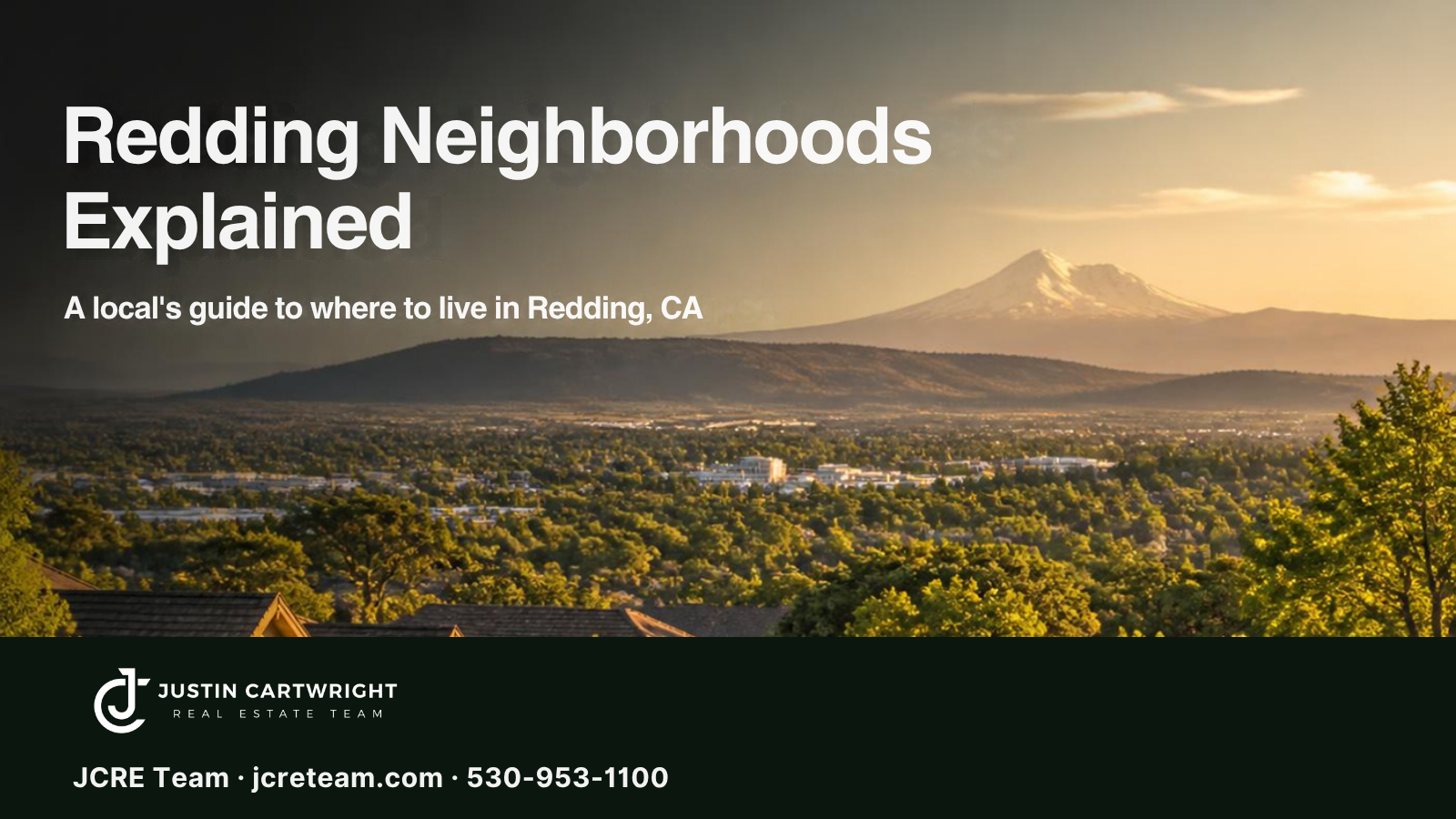
When someone tells me they’re thinking about moving to Redding, the first question is almost always the same: “Okay, but where in Redding?”
It’s a fair question. Redding isn’t a huge city — roughly 90,000 people — but it’s spread out across both sides of the Sacramento River, and the feel changes a lot from one side of town to the other. A newer subdivision on the east side, an older ranch home near downtown, and a hillside place in west Redding with a view of Lassen can all be “Redding,” but they’re very different ways to live.
I grew up here, and my family has been in Shasta County for three generations. Here’s how I’d describe the main parts of town to a friend who’s relocating — honestly, including the trade-offs.
How Redding Is Laid Out (the Quick Version)
The Sacramento River runs right through the middle of Redding, and Interstate 5 runs north–south on the east side of it. Most locals think about town in a few big chunks:
- East Redding / Enterprise — east of the river, mostly the 96002 zip code
- West Redding — west of the river, climbing toward the hills (largely 96001)
- North Redding / Shasta View area — the 96003 side, north and northeast
- Downtown and the central core — older neighborhoods, the river, Turtle Bay
Zip codes are a decent shorthand, but they don’t tell the whole story. Two streets apart can mean a very different price, lot size, and age of home.
East Redding and Enterprise: Convenient, Established, Family-Friendly
Enterprise was once its own community before it became part of Redding, and it still has that neighborhood feel. This is where you’ll find a lot of 1960s–1990s single-story ranch homes, established trees, parks, and quick access to I-5, Churn Creek Road, and the shopping along Hilltop and Dana Drive.
Who it fits: families, first-time buyers, and anyone who wants to be close to everything. Commutes to Mercy Medical Center, Shasta Regional, and most of the retail corridor are short.
Trade-offs: a lot of the housing stock is older, so roofs, HVAC systems, and original plumbing are worth a careful look during inspection. Some pockets are closer to busy roads than you’d want, so I always suggest driving the street at rush hour and on a Friday night.
West Redding: Hills, Views, and Bigger Lots
Cross the river heading west and the terrain starts to rise. West Redding has a mix of older in-town neighborhoods near downtown and newer hillside homes farther out, including areas near Buenaventura, Placer Road, and the foothills toward Whiskeytown.
Who it fits: buyers who want a bit more elbow room, a view, or a quick drive to the trails at Whiskeytown and the Sacramento River Trail. Move-up buyers often land here.
Trade-offs: hillside lots and the wildland edge mean you’ll want to pay close attention to defensible space and homeowners insurance before you write an offer. Insurance availability and cost can vary a lot property to property, so I recommend getting a quote early — not after you’re already in escrow.
North Redding and Shasta View: Value and Room to Grow
The north and northeast side, including the Shasta View area and neighborhoods off Lake Boulevard, tends to offer more house for the money than some other parts of town. You’ll see a mix of older homes, newer subdivisions, and some properties with a little more land.
Who it fits: first-time buyers, investors, and families stretching a budget. It’s also convenient if you work toward Shasta Lake City or spend weekends on Lake Shasta.
Trade-offs: quality varies more block to block here than in some other areas, so comparable sales really matter. This is a part of town where a local agent who knows individual streets earns their keep.
Downtown and Central Redding: Character and Walkability (for Redding)
Redding’s downtown has changed a lot in the last decade, with new restaurants, the Cascade Theatre, and ongoing redevelopment. The older neighborhoods around downtown and near the river have character homes, smaller lots, and mature trees, and you’re close to Turtle Bay, the Sundial Bridge, and the river trail.
Who it fits: buyers who value character over square footage, people who want to bike to the river trail, and some downsizers who’d rather be near restaurants than mow an acre.
Trade-offs: older homes, and like downtowns everywhere, some blocks are quieter than others. I’m always honest with clients about this: walk the neighborhood in the evening before you decide.
Newer Subdivisions and the Edges of Town
If you’re coming from a newer suburb in Sacramento or the Bay Area and want something similar, Redding has newer construction and planned neighborhoods on the edges of town — on the east side, in south Redding, and in the hills. These usually mean newer systems, energy-efficient features, and sometimes an HOA.
Who it fits: relocation buyers who want move-in ready, and anyone who doesn’t want a project.
Trade-offs: smaller lots than older areas, younger landscaping, and HOA dues to factor in. Builders sometimes offer incentives depending on the market, so it’s worth asking.
And if you want more land than city lots offer, nearby communities like Palo Cedro, Anderson, Cottonwood, Shasta Lake City, and Bella Vista are all within a short drive. I’ve written separate spotlights on several of those if you want to dig deeper.
How I’d Narrow It Down
Here’s the process I walk relocating clients through:
- Start with your daily drive. Where’s work, school, or the people you’ll see most? Redding commutes are short by California standards, but crossing the river at rush hour still adds up.
- Decide on lot size vs. location. Big lot and a view, or walkable and close-in? You can usually have one, not both, at the same price.
- Check insurance early. Especially on the west side and near open land.
- Visit at different times. A street feels different at 8 a.m., 5 p.m., and 9 p.m.
- Look at real comps, not averages. Citywide numbers are a starting point — for context, home-value index data put Redding’s typical home value around $376,000 in mid-September 2026, roughly flat year over year — but individual neighborhoods can sit well above or below that.
Let’s Find the Right Part of Town for You
There’s no single “best” neighborhood in Redding — there’s the one that fits your budget, your commute, and how you want to spend your weekends. If you’re relocating, I’m happy to do a video tour of a few areas or put together recent sales by neighborhood so you can compare apples to apples.
Give me a call or send me a note — no pressure, just honest local answers.
530-953-1100 · jcreteam.com/contact · [email protected]
About Justin Cartwright — Justin Cartwright is a third-generation Shasta County resident and licensed REALTOR® with Waterman Real Estate in Redding, CA. He and the JCRE Team specialize in helping buyers and sellers navigate the Redding and greater Shasta County market with honest guidance and genuine care. DRE License #02093872 · Waterman Real Estate, 1760 Churn Creek Rd, Redding, CA 96002 · 530-953-1100.
Sources: Redfin neighborhood data (Enterprise, Redding); home-value index data reported mid-September 2026 via foreclosure.com market page. Neighborhood descriptions reflect local knowledge; always verify current comparable sales for a specific property.